Arkansas
Superintendent Reed of the Cummins State Farm was busy receiving new inmates, white men who crawled out of the "bus" under guard just as the Lomaxes drove up to his office on May 20, 1939. John Lomax's conference with the office was only long enough to explain his mission, present his letter of introduction from the Governor of Texas, get permission to proceed and information about the location of camps and the names of some of the captains. Captain Acklin, who was apparently in charge of the African-American farm workers, offered the Lomaxes a bed for the night and breakfast.
The Lomaxes first went to Camp #6, where John Lomax had previously found some songs. There they found Captain Allen in charge, who came riding up from his inspection of the fields and recognized John Lomax at once. Allen had formerly been in charge of a camp near Little Rock where John Lomax had recorded previously.
It was he whose wife complained that she was kept busy repairing the right armhole of his shirts, which tore loose when he flogged the boys in the field when they slackened work. 1939 Southern Recording Trip Fieldnotes
After a bountiful supper the Lomaxes, the Allens and some guests adjourned to the barracks where African-American prisoners were incarcerated. By the aid of kerosene lamps and flash-lights the Lomaxes set up the machine. John Lomax explained to the prisoners, through the bars, the purpose of his trip and what kind of songs he wished to record. He asked for volunteers. After several rejections, a "big fellow" timidly offered ► Mary Mack Dressed in Black
This Mary Mack proved to be was entirely different from other Mary Macks, at least after "buttons up and down her back.", and even there she had only "three or four" instead of 24. At any rate "Mary Mack" had opened the bars of the barracks for Willie Williams, and we saw that he was doing his best to think up other songs that might delay his recommitment to the barracks. "Yes, he knew other songs, but couldn't git 'em togather just then." 1939 Southern Recording Trip Fieldnotes
As Williams searched his memory, John Lomax appealed to the other prisoners "What have you boys heard him sing? Help him out here." "Sing Jody Grand, Garmouth" one of the prisoners called. Willie "Garmouth" grinned, nodded his head and sang ► Joe de Grinder a mule-driving song which Garmouth used in the field. Williams told the Lomaxes that he was brought up on a farm, had a wife and one child, and was given three years and seven months for shooting a boy.
After the songs of Willie "Garmouth" Williams were played back with the announcement of his name, other prisoners crowded up to the bars to offer their songs. Blues were particularly popular, "sorrow songs", as one of the prisoners called them. ► Milk Cow Blues, ► Corn Field Blues, ► Po' Laz'us and ► Boll Weevil. The Captain had allowed the Lomaxes stay past nine o'clock, but the kerosene lamps were burning low and the Lomaxes were packing up to go when a "big fellow", one of the quartet who had sung a lined hymn, offered to sing the iconic ► John Henry
Just a week or so after we made these recordings a storm blew down the barracks of Camp #6. We read in a newspaper that two of the boys who tried to get away in the darkness were overtaken by the hounds and were shot when they refused to surrender. Others were captured. We hadn't the heart to enquire whether Arthur Bell and "Garmouth", are among the dead or the missing, or are still singing their John Henry and shouting their "Git up, Red" and "Gee, Bill" in the fields. 1939 Southern Recording Trip Fieldnotes
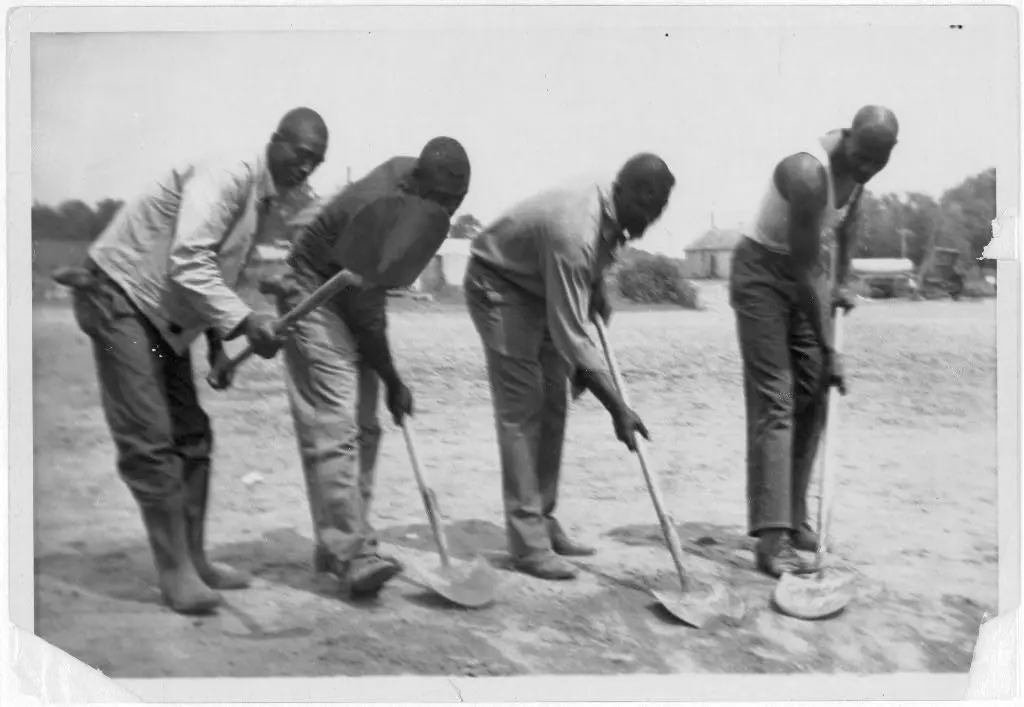
The Lomaxes spent the night in the home of Captain Acklin, about four or five miles away from Camp #6. After breakfast the next morning, Sunday, they talked to Captain Miller who had charge of the African-American barracks of Camp #1 nearby. Trusties sat on guard with guns ready in case of a break. Other trusties helped get the men together. The convicts were very poorly dressed; proceedings had to wait until some of the men could get on more clothes when they saw Ruby Lomax, a woman, in the car. The Captain said that some of them had better clothes; "but", he said, "Sunday is the day when the trusties in charge of clothing go around among the groups and pass out cleaner or better garments to those who appear to need them most. Some of the fellows try to look their worst. No, they don't have stripes or any other kind of uniform."
Later Superintendent Reed boasted about the large balance that he had built up for the state prison system. We heard no complaint from the boys about food, and we made no comment to Supt. Reed, but we thought privately that some of that surplus might well be used for soap and for clothes to replace the rags that the boys were wearing that Sunday morning. 1939 Southern Recording Trip Fieldnotes
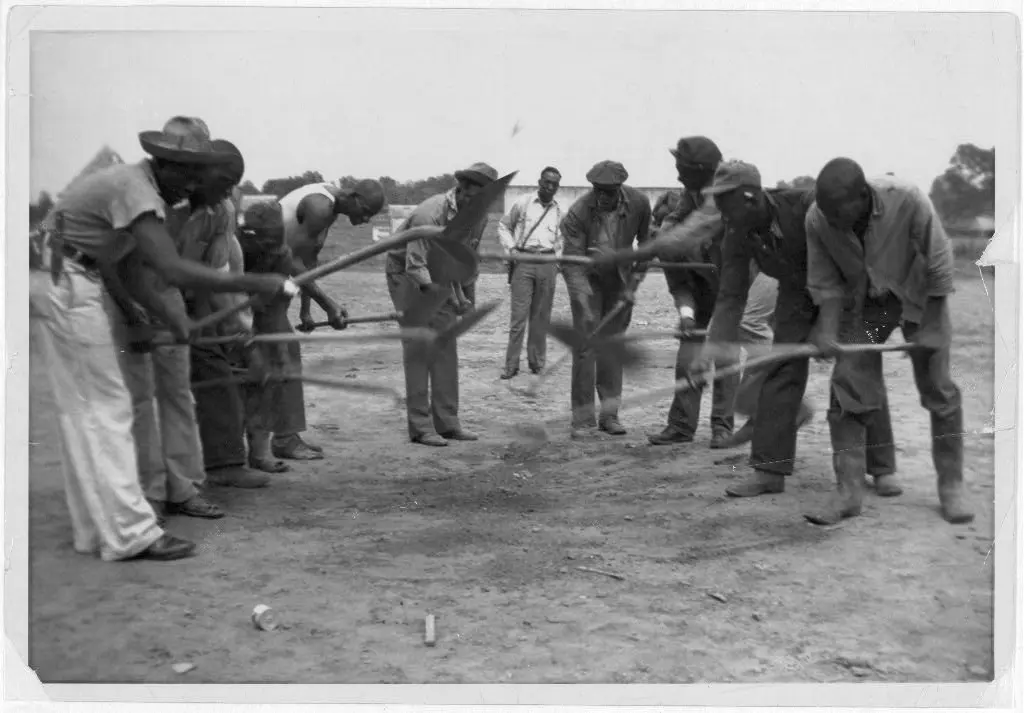
After several experiments with shovels and picks in an effort to get the right sound effects, a group finally recorded ► Rock Island Line in the mess hall where the machine was set up. Laroy Martin, a 'cripple', volunteered to sing ► Crawdad, with a small group of assistants. When John Lomax asked for game songs or children's songs, Virgil Lamb offered ► Long-tailed Rat, amid great guffaws of his fellows. Then Willie Johnson tried to recall a version of the "Ram of Darby", though he called his version ► Didn't He Ramble which he used to hear his grandfather sing. Willie, known as "Little Life" because of his sluggish movements, could not "get together" many of the stanzas.
In the afternoon, finding Superintendent Reed at home, the Lomaxes received his permission to interview the African-American women who were housed in the rear of the superintendent's residence under the supervision of Mrs. Reed. The girls who were interested or curious gathered into a large room which served as a sewing room and a laundry. At first nobody knew anything. Then John Lomax told them about the girls of Goree Farm in Texas. One of the women, who "lived in Texas but got into trouble in Arkansas for something I didn' do", knew Hattie Ellis and her singing. The Lomaxes felt that some of the songs offered came from the radio or from the phonograph, but in most cases the women had changed them and improvised them to suit their own fancy and to make them their own. Songs recorded include ► Hush Little Baby and ► I Goin' Pack My Suitcase
We left the headquarters of the Arkansas state farm as soon as the women convicts had been called to their dormitory and we had told Supt. Reed goodbye. He gave us directions for finding a new camp, Number 9, out from Arkansas City. We bought some supper at the nearby town of Varner, but we could find no place to sleep. We followed the rough and winding highway to McGehee, Arkansas, where we found a comfortable hotel. Early next morning we started out for Camp #9. At Arkansas City we stopped for further directions. This formerly prosperous town is all but dead now. 1939 Southern Recording Trip Fieldnotes
Newly made red-clay roads led the Lomaxes to Camp #9. Captain Burt Clayton invited them to dinner and extended the noon rest period so that the prisoners might make recordings for John Lomax. This camp was at that time only three months old. The Lomaxes report that the men here were better dressed than the men at Camp #1. They gathered under the large trees in the dormitory yard and sang and joked. One of the men busied himself making a list of nicknames in which this camp especially seemed to abound. At a penny per nickname he earned a considerable tip. The men were willing but no significant songs were contributed.
A partial list of nicknames current at Camp #9: Sawmill, Big Windy, Railhead, Longbones, Little Man, Black Rider, Helena, Cool Goose (fromcrap game), Hop-an'-bow (crippled), Scasehound ("dat's his nitname"), Tang (cross-eyed, "Look Easttryin' to see West), Step-in-de-mouth (Mule stepped in hsi mouth and made it "that way"), Scabow (scabow de cotton means get along wid it right fast"), Colorado Red, Salty Dog, Garmouth, Dad, Blue, Wild Mna, Chicken, Slack Britches, Cheatem, Rooster. "Mattie" is their "pet name for an automatic" 1939 Southern Recording Trip Fieldnotes