South Carolina
From Raiford we went up the coast highway through Brunswick, Savannah, Charles where we spent the night, though I think we should not have stopped, had we known about the polio epidemic, the worst in S.C. for many years. For that reason we had to forego gathering little Negro children together at Murrells Inlet, as we had planned, for playparty songs, - twenty-five dollar fine for such. Tourist camps and houses were not allowed to take in children under twelve years without some kind of statement from a doctor. But we did get some good individual singers, among them our old friend Mrs. Floyd who learned to read when she received her first love-letter Letter from Ruby Lomax to her family
At Murrells Inlet, South Carolina, the Lomaxes were assisted by Mrs. Chandler, curator of the museum on the grounds of the Brookgreen Garden. She had already arranged for their friend Minnie Floyd to come sing. The Lomaxes set up their machine in the center of a mose hung liveoak grove, in the home of Mrs. Chandler's father, where they could get electric current. Mrs. Floyd came and made some recordings, among them a two part ballad called ► Lord Bateman (Part 1 of 2) ► Lord Bateman (Part 2 of 2), as did an African-American schoolteacher Annie Holmes, who brought two or three small children with her to sing game songs such as ► I Lost My Master's Barn Key
The Lomaxes were invited to Clemson, South Carolina by Ben Robertson Jr, who thought that they might be interested in seeing the throngs of people who gathered to such a "singing" as was advertised to be held later that Sunday at Toccoa Falls, Georgia. A day before the festival Mr. Robertson gathered to his home some of his African-American friends, a quartet of working men, and a quartet of young people from the Owens family who made many recordings among them ► The Goblin Man and ► Let Me Fly
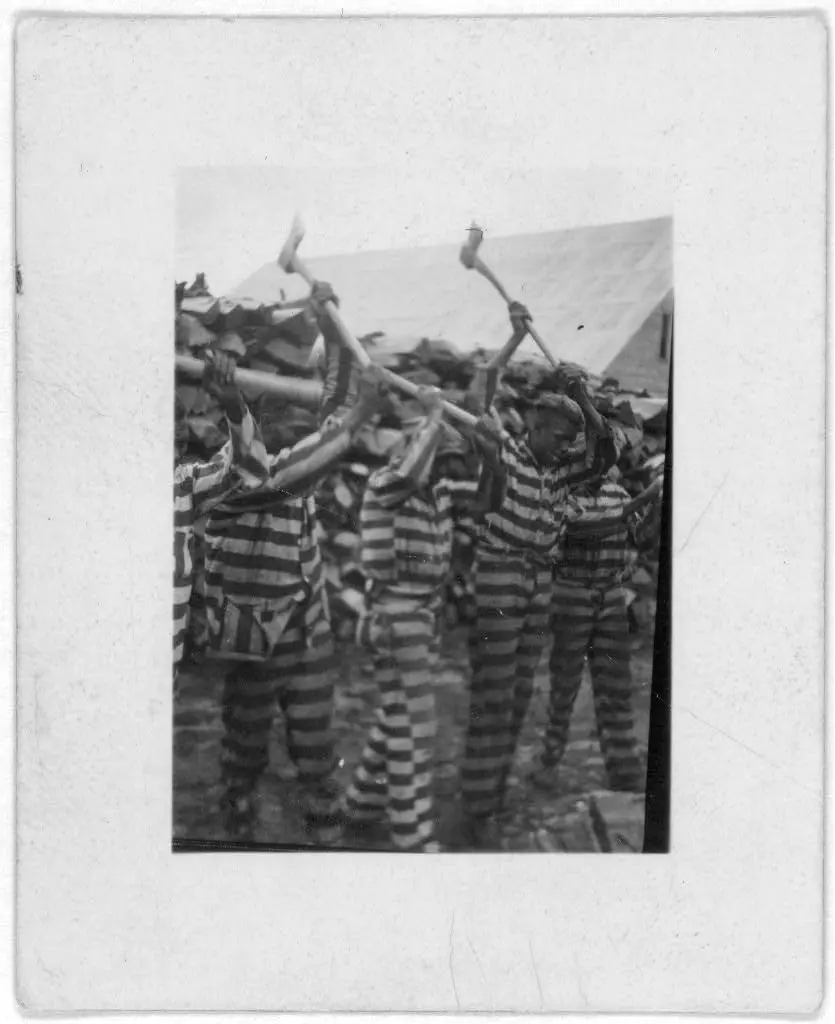
On Sunday morning, before the singing festival, the Lomaxes "saw a sight that shocked us all" - eighty African-American tied by ankle chain to a long large common chain. The men were good-natured about it, and when the singers moved, the whole group made no complaint at having to move too. When a singer would say, "This is as clost as I kin git to the mike", the other men would shuffle their leg-chains along the big chain until the singer could reach the mike. This was in group singing, where the mike could not be moved to one singer. Robertson and a young reporter who was with the Lomaxes did not know that such a custom existed in South Carolina and they immediately made resolutions. John Lomax later wrote to the Governor of South Carolina
My dear Governor
Since 1934 I have spent much of my time travelling throughout the south making records of folk songs. In this work I have visited Negro convicts in all Southern penitentiaries, and in many of the road camps. In making my reports to the Library of Congress I have found so much unjust criticism and misinformation about the treatment of Negro convicts in the South that a year or so ago I wrote a news article explaining the widely misunderstood term "chain gang". In this story I stated that I had never soon convicts chained together. (As a matter of fact no instance of physical brutality in all my experiences have come under my personal notice). I can no longer make this claim.
A few Sundays ago I visited the convict road camp in Anderson County, South Carolina, near Clemson College. There I saw a hundred negroes resting in their quarters, all fastened togother on a single long chain, so that when a small group agreed to sing for me, the entire bunch had to move out of the tent and stand in the open.
I do not know of the special reasons that make it necessary for these men to be chained together on their rest day. I only know that I have never before seen a practice which seemed to me unnecessary and inhuman.
I am writing to you, Governor, only in the hope that, through the power of your office and the high esteem in which you are held by your people, you can have this situation corrected. I am a Texan and I was for years on the Faculty of the University of Texas, but my father, James Avery Lomax, was born and reared in Abbeville/District, South Carolina, while my mother came from Alabama. By inheritance I hold dear the righteous ideas of a Southern man.
Letter from John Lomax to the Governor of South Carolina
For the evening their host Mr. Robertson had investigated rural African-American servics and the Lomaxes were told that the Little Hope Baptist congregation would have services. It looked like it was going to rain, but they all started out. On the way they learned from African-Americans on foot that the group was gathering at the school-house which was nearer than the church house. When they arrived some fifty people of all ages had gathered. The house was dimly lighted but the Lomaxes set to work as quickly as possible, since lightning was beginning to flash. Perhaps the congregation did not feel at home, but response came slowly. Finally the Lomaxes did record several lined hymns and spirituals, including ► New Buryin' Ground and ► The Roughy, Rocky Road, and a cradle song called ► Your Mamma's a Lady
By the time we had packed up ready to go, the rain was coming down in sheets. Mr. Robertson braved the storm to back the car as close to the door as possible; with the help of the deacons we loaded up and with the careful driving of Mr. Robertson we slid safely along the clay roads home. I couldn't help wondering what the "Sunday Best" of those faithful church members looked like after they had waded through the rain over the several miles that many had to travel. They are a very patient, fine-spirited people. 1939 Southern Recording Trip Fieldnotes